Jewellery making and alchemy?
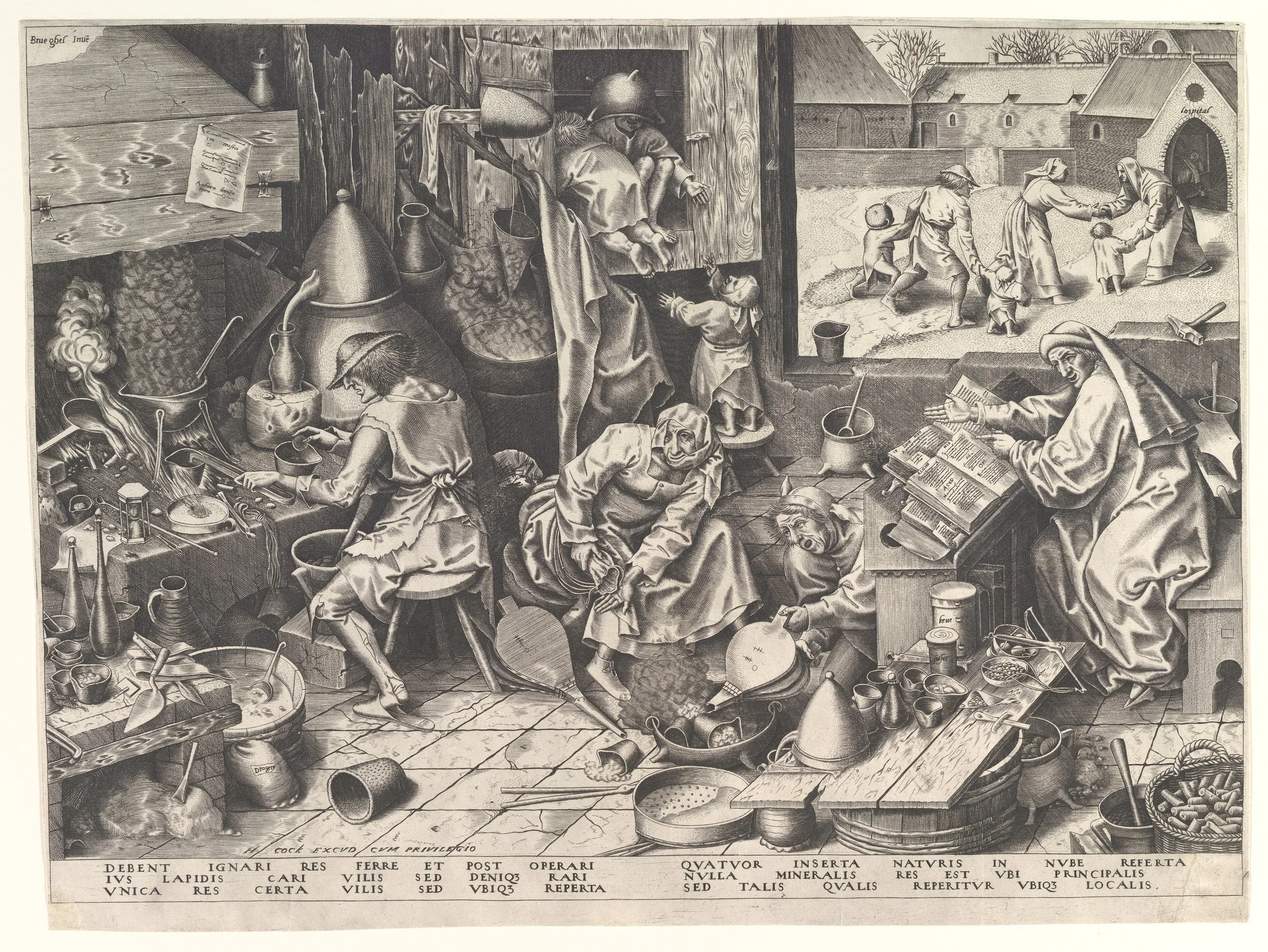
The Alchemist - Pieter Bruegel the Elder (source The MET, public domain)
It is not uncommon for jewellers to make occasional references to alchemy. The materials and some of the processes are pretty much the same, though very few would probably claim that their jewellery-making is motivated by transmuting substances or finding the philosopher’s stone. Nevertheless, most would attest to psychological, maybe even magical, but certainly meaningful practice that reflects and is reflected in their lives.
As someone doubling in depth psychology and metalsmithing, I'm always keen on bringing in ideas from literature to explore what might be going on, and I'm also very happy to melt some metals and put those ideas to the trial by fire. In this case, a literal one. I'm particularly interested in the interaction between the maker and the made product, how do we relate to each other, and how certain ideas and objects come to life through genuine engagement. It is sometimes linked to alchemical approaches of working with materials. One of the people who had a lot to say and write about alchemy was C. G. Jung. And even though his perspective remained in the realm of the psyche, he grappled with the processes and materials, too. Here is a paragraph that made me smile the other day:
But the greatest of all riddles, of course, is the recurring question of what the alchemists really meant by their substances. What, for instance, is the meaning of a “sal spirituale”? The only possible answer seems to be this: chemical matter was so completely unknown to them that it instantly became a carrier for projections. Its darkness was so loaded with unconscious contents that a state of participation mystique, or unconscious identity, arose between them and the chemical substance, which caused this substance to behave, at any rate in part, like an unconscious content. Of this relationship, the alchemists had a dim presentiment – enough, anyway, to enable them to make statements which can only be understood as psychological. (Collected Works 14, para. 336)
Whether alchemy was a carrier for Jung’s projection must remain a mystery, but I thought it was very sweet of him to think that knowing the chemical constitution of, for example, silver would change anything about the work with it. In fact, when melting, soldering, blackening, heating, cleaning, whitening or anything else, I couldn’t care less about the number of protons and electrons and where it stands in relation to other elements in the periodic table. What really matters is what it is doing at that particular moment in time on my bench. And if you have handled enough silver, you know that two pieces with the exact chemical composition can behave differently. Or that different people working with the same material (tools, instructions, environment, etc.) experience very different processes and outcomes. That’s when our unknowing becomes exposed, and we resort to psychology. Or theology on that part. Stories of soldering gods and fairies are deeply embedded in jewellery-making lore and unlikely to disappear under the weight of enlightenment and scientific knowledge.
So what is happening there when you are doing everything right, and nothing on the surface of the Earth can make your solder flow into that perfect joint you cut minutes earlier? Shall we agree with Jung that the conscious knowledge of chemical matter changes the relation to the material? Or did the alchemists know something about the process that can’t be reduced to methods and measurements? Or do we still know way too little, even with current-day chemistry and physics, that we still can freely project our own psyche onto a piece of metal?
There is the idea that we can assume control if we know enough, and if we can't control the process, it comes from not knowing. I'm a big fan of not knowing in this instance, as it corrects our ideals of mastery as an ability to impose any form on any matter. A master jeweller is not the one who can create anything she wants, but the one who is able to work with the material and correct mistakes, or make them seem intentional as she progresses through the piece. It leaves the space for mystery, creativity and new possibilities. If we knew everything beforehand, we would be deprived of the joys of creative experimentation, chance and serendipity, but also frustration and failure, which stimulate new ways of working. We would learn very little about ourselves and our relations to the world through the vessel of the creative process. And that would degrade any art and craft making to a pure production for consumption. I’m sure that is not the whole story.
So, perhaps, there is truth in understanding jewellery making through the alchemical lens. Oftentimes, it reveals more about us, what people we are, than about the possibility of turning lead into gold. I would rather cheekily add, it reveals more about the material's intentions, too. But that might remain in the realm of participation mystique - my offering to the alchemical crucible.